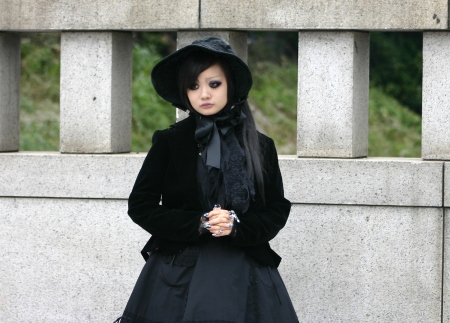
People always feel worried when they change their usual image into completely different version. They are afraid they look weird as the perceptions around your image, even in the slightest and between family members and close friends. If so, it is easy to imagine what is the reaction to a tomboy wearing so girly Lolita dress?
Actually, no matter how boyish you are, once you dress up in adorable Lolita, everything is out of your expectation. Lolita fashion can make you feel many things. It can make you feel like a princess. It can make you feel like there are only you. It can make you feel girly and pretty and everything good that you ever wish for. I don't intend to advertise for Lolita fashion and only want to share pleasure from my a best friend who is really boyish, however, is exciting and can't help crying when wearing a sweet Lolita dress. I think she never thought she can look so girly. That is the reason why she cried.
My view is it is your right whatever you wear and never make a haste decision before trying a certain style. Don't casually say you don't suit the style.
2011年1月18日星期二
2010年12月8日星期三
Worldwide Lolita Fashion
In the Picture, two Chinese-Canadian girls wearing doll like Lolita dress walking on the street of Vancouver attract many passerby. It is said forty girls at least are the fan of Lolita fashion in Vancouver, and these enthusiast wear Lolita clothing almost every day and everywhere. As a matter of fact, Lolita fashion have been out of Japanese limit and increasing popularity all over the world such as Chinese Mainland, Hong Kong and Taiwan of Asia, England, France and America of Europe. More and more Lolita clubs are built by these fans to gather and communicate anything about Lolita fashion.
2010年12月6日星期一
The Difference Between Vogue Lolita Fashion And Japanese Lolita Style
It seems Vogue has caused some confusion in their labeling of this fashion trend. The Lolita fashion subculture previously mentioned on this forum unfortunately shares a name with Vladimir Nabokov’s novel, and often establishments like Vogue mix the two up. The Japanese Lolita fashion subculture has nothing to do with the novel Lolita, though. In fact, the two could not be further apart, as I will elaborate on in a moment. Though some elements of the Vogue 'Lolita' fashions are quite cute, it is important to distinguish these 'nymphet'-inspired styles from the elegant Victorian-inspired Lolita fashions from Japan, and it would have been preferable if Vogue did their research before labeling these fashions as Lolita. It's not that they are not Lolita; it's just that they are the 'other' kind of Lolita rather than the Lolita styles from Japan, and it's often difficult to make the distinction.
Now that this topic has come up, it seems like an excellent opportunity to share some more information about the Japanese Lolita fashion which is now gaining popularity in the West.
Lolita is a Japanese street fashion which is primarily influenced by the aesthetics of the Victorian and Rococo eras. Elegance, cuteness and femininity are the guiding principles of the fashion, and ornamentation is plentiful in the form of lace, bows, ribbons and ruffles. The fashion movement has changed and evolved greatly since first starting in the 1980s, and for an obscure Japanese subculture, it has gained quite a bit of momentum in the West.
A 'Lolita lifestyle' is followed by many Lolitas, which promotes a philosophy of living beautifully rather than just dressing it. This is quite a wonderful sign of aesthetic restoration, in which girls and women undertake many 'traditional' feminine activities such as baking and sewing, and often surround themselves with Rococo or Victorian-inspired architecture, music and art.
The term 'Lolita' itself is used to describe quite a defined, specific look which adheres to certain guidelines and principles, such as bell-shaped knee-length skirts, blouses, headwear, quality materials and proper color coordination. Within these guidelines, however, there are several different substyles and looks, each with their own defining features.
Gothic Lolita, also known as Elegant Gothic Lolita (abbreviated as EGL), is perhaps the most well-known style outside of the subculture. It primarily uses dark colors such as black, often accented by white or electric blue, and motifs such as ornate iron gates, old churches, crucifixes, bats or anything suitably Gothic are popular.
Sweet Lolita is currently the most popular style within the Lolita community, and is strongly influenced by the decadent Rococo era. It is the most over-the-top and childish of all the styles, and often has excessive bows, lace and ruffles adorning the outfits. Colors are generally pastels, including pink, baby blue and white, and cute motifs such as crowns, keys, cakes, hearts and cherries and popular.
Classic Lolita is perhaps the most beautiful, elegant and feminine of the Lolita substyles. While Gothic and Sweet aim for a more childish look, Classic Lolita embodies the elegance of a refined Victorian lady. It is the most historically inspired of the styles, and is absolutely ideal for the plus-size figure. Lower necklines are acceptable in the style, as well as more form-fitting outfits and maturer cuts (that being said, overt sexuality is still a huge no-no, again highlighting the difference between Lolita and the 'other' Lolita). Darker colors such as burgundy and forest green are used, as well as pretty floral prints and lighter pinks and blues.
Generally, punk Lolita features many motifs such as tattered fabric, ties, safety pins, chains, screen-printed fabrics and plaids. The most popular garments are blouses and skirt. Punk Lolita outfit can be sub-classified into two forms. The first is a outfit with a bell shape knee length that conforms to the general shape of Lolita but not the same clean lines with other styles. Accessories and fabric are important to this style. The second is much lighter feeling and much girlier than a normal style. It features frills and bows throughout. The skirt is neither knee length and bell shaped nor skin tight and crotch length. Punk Lolita girls commonly wear a pair of boots and long socks with strips.
As you can see, there is quite a large difference between the Vogue 'Lolita' fashions and the Japanese Lolita style! Truly, the two are not related at all.
订阅:
博文 (Atom)